
YEG Exotic Plant Crowd
Propeller Plant #01
Description
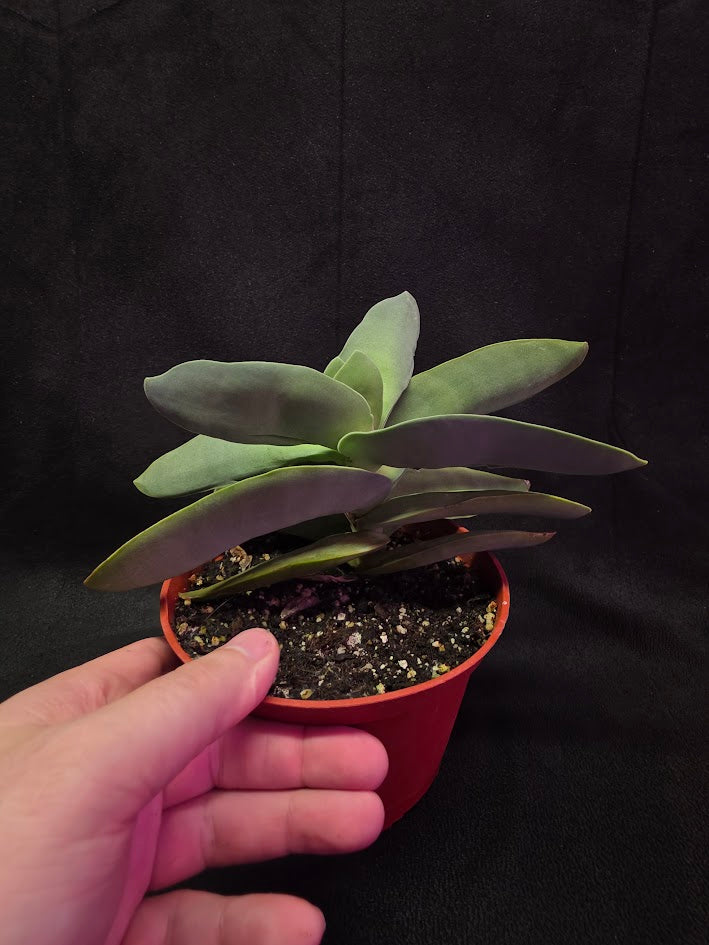
Crassula perfoliata var. falcata, commonly known as the Propeller Plant, Airplane Plant, or Scarlet Paintbrush, is an extraordinary succulent highly prized for its distinctive propeller-shaped foliage, silvery-grey colouration, and spectacular clusters of vibrant red flowers. Native to South Africa, this remarkable member of the Crassulaceae family naturally inhabits rocky, relatively dry environments where it has adapted to intense sunlight and periods of limited rainfall. Its unusual architectural appearance and exceptional flowering habit make it a particularly desirable specimen among collectors of uncommon succulents and ornamental desert plants.
The most remarkable characteristic of the Propeller Plant is its beautifully structured, elongated, sickle-shaped leaves arranged in opposite pairs along upright stems. Each pair of leaves extends outward at an angle, creating a distinctive appearance reminiscent of an aircraft propeller. The thick, fleshy foliage displays shades of silvery-grey, powdery blue-green, and muted green, with a smooth, matte surface that enhances its sophisticated appearance. The overlapping arrangement of its leaves creates an impressive architectural silhouette that distinguishes this species from many commonly cultivated Crassula varieties.
Crassula perfoliata var. falcata exhibits a naturally upright, moderately branching growth habit, gradually developing substantial stems adorned with numerous pairs of sculptural leaves. Mature specimens can reach approximately 30–60 centimetres in height under favourable growing conditions, although container-grown plants may remain considerably smaller. Established specimens may produce additional branches and offsets, creating an increasingly full and visually impressive display.
One of the most captivating characteristics of the Propeller Plant is its spectacular flowering habit. Mature specimens can produce dense, rounded clusters of small, star-shaped flowers displaying brilliant scarlet, crimson, and orange-red colouration. These striking flower clusters emerge above the silvery foliage on upright stems, creating an extraordinary contrast against the plant's subdued blue-grey leaves. Flowering typically occurs during the warmer summer months, and established specimens may maintain their vibrant floral displays for several weeks. The flowers can also attract butterflies and other pollinators when cultivated outdoors under suitable climatic conditions.
The Propeller Plant thrives in bright light with several hours of gentle direct sunlight or beneath suitably positioned full-spectrum LED grow lights. Adequate lighting is particularly important for encouraging compact growth, maintaining its characteristic silvery foliage, and supporting successful flower production. Plants cultivated under insufficient lighting may develop elongated stems, wider spacing between leaves, and reduced flowering. Gradual acclimation is recommended when introducing the plant to stronger direct sunlight to prevent foliage scorching.
Unlike tropical foliage plants that require elevated humidity, Crassula perfoliata var. falcata prefers relatively dry growing conditions with excellent air circulation. Average to low household humidity is generally suitable, and supplemental humidity is unnecessary. Prolonged exposure to excessively humid, poorly ventilated environments should be avoided, as these conditions may contribute to fungal issues, stem deterioration, and root rot.
An exceptionally well-draining, porous growing medium is essential for maintaining healthy root development. Suitable substrates may include high-quality cactus and succulent potting soil amended with generous quantities of pumice, perlite, coarse silica sand, lava rock, or other appropriate mineral-based materials. A substrate containing approximately 50–70% mineral components provides a useful starting point for cultivation. Containers should always feature adequate drainage holes to prevent excessive moisture accumulation around the root system.
Water thoroughly when the growing medium has dried completely, allowing excess water to drain freely from the container. The Propeller Plant stores substantial moisture within its thick, succulent leaves, allowing it to tolerate periods of reduced water availability. Prolonged overwatering is one of the most significant risks when cultivating this species. Watering frequency should be reduced considerably during periods of slower growth, particularly throughout the cooler winter months when lighting intensity and evaporation rates decrease.
Moderate to warm temperatures of approximately 18–29°C provide favourable conditions for active growth. Although established specimens can tolerate somewhat cooler temperatures when maintained in dry conditions, the Propeller Plant should be protected from frost, freezing temperatures, and prolonged exposure to cold, damp environments. During the warmer Canadian summer months, specimens may be cultivated outdoors in a sheltered, sunny location following gradual acclimation. Plants should be brought indoors before nighttime temperatures become excessively low.
During periods of active growth, a diluted, balanced or low-nitrogen cactus and succulent fertilizer may be applied approximately every four to six weeks to support healthy root development, foliage production, and flowering. Crassula perfoliata var. falcata does not require heavy fertilization, reflecting its natural adaptation to relatively nutrient-poor environments. Excessive nutrient applications may encourage weak, elongated growth or contribute to mineral accumulation around the root system. Fertilization should be reduced or discontinued during periods of seasonal inactivity.
The Propeller Plant can be propagated vegetatively through healthy stem cuttings, leaf cuttings, or the separation of established offsets. Cut surfaces should be allowed to dry and develop a protective callus before being placed into an appropriately well-draining propagation medium. Maintaining stable warmth, bright indirect lighting, and careful moisture management can encourage successful root establishment. Stem cuttings are generally a practical method for producing substantial new specimens while preserving the distinctive ornamental characteristics of the parent plant.
Occasional pruning may help maintain the desired size and shape of mature specimens while encouraging additional branching. Spent flower stalks can be carefully removed once flowering has concluded. The plant generally appreciates being cultivated in a moderately snug container and does not require frequent repotting. Repotting every two to three years, or when the root system has outgrown its existing container, is generally sufficient.
Crassula perfoliata var. falcata is intended for ornamental cultivation rather than consumption. As the ingestion safety of this particular species is not well established, it is recommended to keep the plant out of reach of pets and young children.
With its extraordinary propeller-shaped foliage, elegant silvery-blue colouration, dramatic scarlet flowers, and distinctive upright growth habit, the Propeller Plant is an exceptional statement specimen for any specialized succulent collection. Its unusual architectural characteristics provide a striking contrast against Echeveria, Haworthia, Aloe, Gasteria, and other ornamental succulents. Particularly suitable for sunny windowsills, decorative ceramic planters, indoor grow-light setups, greenhouse collections, and carefully designed miniature desert landscapes, this remarkable South African species combines sophisticated botanical architecture with spectacular seasonal floral displays. Its drought-tolerant nature and relatively approachable care requirements make it a rewarding choice for both beginner and experienced succulent enthusiasts.
Please note that each living plant is unique and may vary slightly in size, shape, leaf count, colouration, branching structure, and growth habit. Juvenile specimens may not yet display the substantial foliage and pronounced architectural characteristics associated with mature plants. Flowering frequency, flower cluster size, and colour intensity are dependent on maturity, lighting, seasonal changes, and overall growing conditions. Plants are not guaranteed to arrive in bloom. Providing generous lighting, excellent drainage, stable temperatures, and careful moisture management will help encourage healthy new growth and future flowering following shipping and acclimation.
Care & shipping
Bright indirect light, high humidity, water when the top inch of medium dries. Shipped with insulation and a heat pack in cold months.
How we pack
Root systems are wrapped damp, foliage is braced, and the box is insulated. Orders ship early in the week so nothing sits in transit over a weekend.
Also available